

Emergence
The fourth and final step of 'The Labyrinth and the Dancing Floor'

Greetings everyone and happy Autumn equinox! Two years ago on this day I began this column, and this Labyrinth series at the end of the winter. It promised to explore ‘the metaphysical work required to make a gaolbreak from the machinations of Empire’, following the four steps of an ancient spiral dance.
This is the last step of the dance, what happens as we approach the exit. It’s inspired by the migratory fish that swim in our rivers and seas, undergoing transformation as they shift between sweet water and salt. Both creatures face the difficult autumn journey of return to the source of their beginnings:, the salmon, who swim upriver to spawn, and the European eel. who begin their epic migration to the Sargasso Sea in the North Atlantic.
You might think, as I did, that that emergence is coming out of something and leaving difficulty behind, but I discovered, as I wrote this piece, it is in fact about becoming a different kind of creature for a world turned upside down. The Labyrinth is a training ground for a re-entry.
I wanted to live a deliberate life. To make meaning, to explore. I left the dazzling self of cities behind, not because I did not love the world but because I did. Not because I didn’t love you but because I did. We needed to be so much grander and kinder than we were and we could not be in those tiny shrinking rooms, those offices and restaurants, cut off from our ancestors, our fellow creatures, the mysteriousness of life, from each other. To go into the Underworld was the way open to me. So when the King of the Dead emerged through the shivering poplar leaves I did not run away, I went joyfully, though it cost me everything.
from ‘Saying Goodbye’, The Earth Dreaming Bank
At the end of her passage through the Underworld, Inanna is left hanging on a hook. Her faithful attendant Ninshubar, has petitioned her sky fathers for help, but only the god Enki comes to her aid. He sends two beings created from the mud under his fingernails, who assume the shape of flies, so they can pass undetected though the keyholes of the seven gates of the kur. They carry the water of life and the food of life, and words of consolation for her furious sister Erithkigel, who is suffering giving birth. They are the gala-tura and the kur-jara. And their distinguishing feature is they are neither male nor female.
I was eight years old when I first I read about Persephone and the six pomegranate seeds. The myth about her ‘fall’ into Hades captivated me and has stayed with me all my life. This equinox marks the moment she returns to the Great Below to become Queen of the Dead, not so much as a time of mourning but of celebration.
Most of the teaching and writing stored in The Red Tent hinge on the trans-formational nature of the female-led Underworld myths of the ancient world. Stripped from their patriarchal patina, they reveal the initiation structure for what was once known as the Great Mysteries: the four tasks set for Psyche by the Greco-Roman goddess, Venus; the four steps of the dance in and out the Labyrinth, as instructed by the Minoan goddess, Ariadne.
The poet Homer writes that the master craftsman of the Labyrinth, Daedelus, ‘made fair Ariadne a dancing floor’ and put around the shield of Achilles, a ring of dancing girls and boys as they emerged from a cave. History makes Daedelus the architect of a prison maze, in which these young people are devoured by a beast held at its centre. But beneath these ruins at Knossos, you can find a spiral map for a ritual journey where the core encounter is not with a monster, but the celestial Bull. The whole point of this journey is that you come back.
The Labyrinth in this series is both civilisation’s prison and an ancestral initiation chamber. The work that happens there is both a liberation from capture and an awakening to the dancing floor of Earth and sky.
What comes to me now however, as I search for the exit. is not the Cretan myth but the resurrection story of the Sumerian goddess of Heaven and Earth, Inanna. Here, the embodiment of Venus is not the stern instructor of young men and women, but is undergoing an alchemical process herself. In the kur, the Underworld, she is forced to divest herself of all her worldly powers, be judged, stripped naked and left to hang, for dead on a hook.
Her only way out is with the help of her divine allies.
The Jar
Earthbound symposium Himmelbjerggården. Ry, Denmark


It’s a gathering.
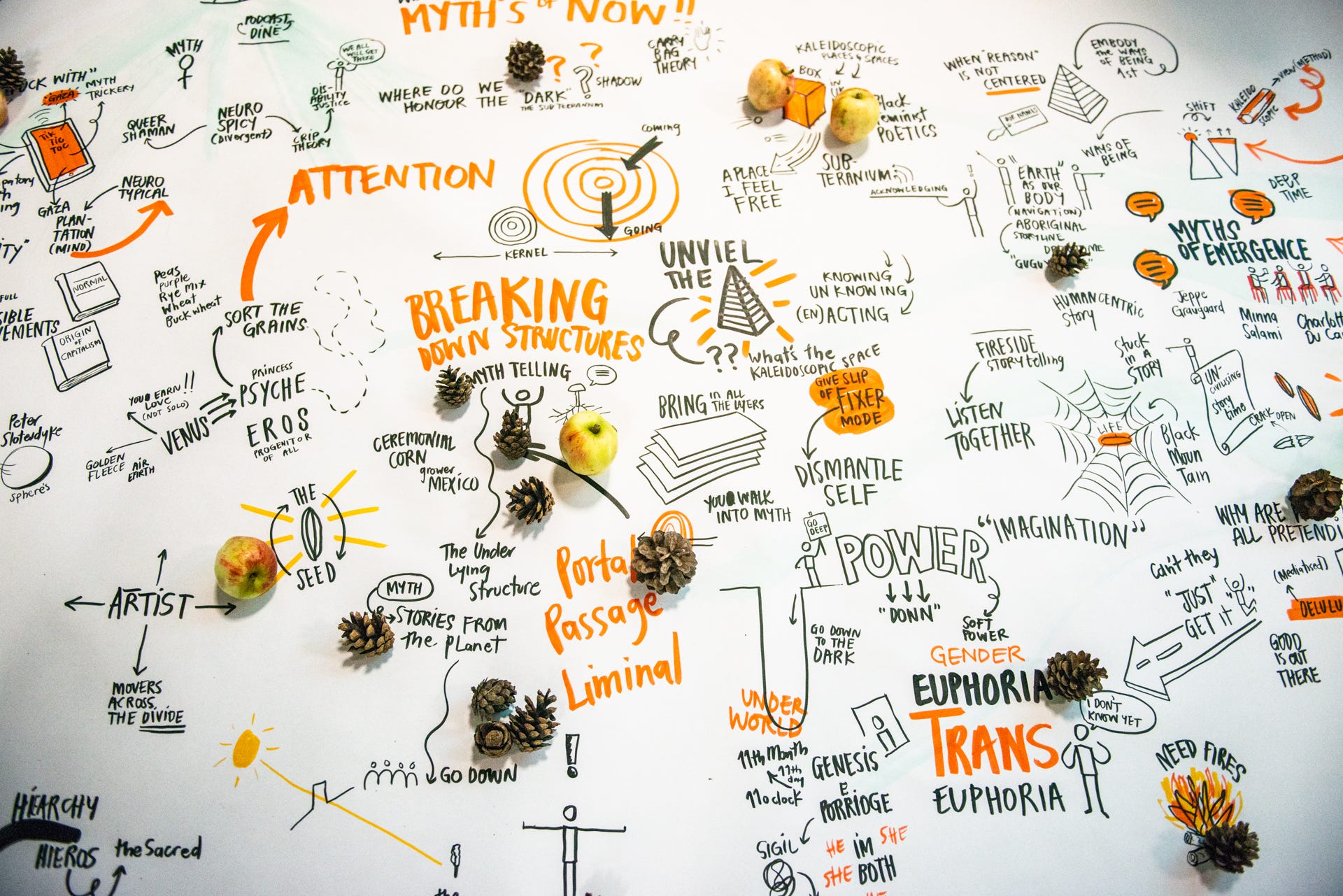
I am here to talk about seeds at the harvest time of Lughnasadh: the radical seeds we carry inside of us, and the myths of emergence that reminds us why they need to germinate. I am sharing a platform with fellow uncivilising voices: with queer ‘neuro-spicy’ artist Venus Jasper, speaking on dissolving boundaries in the murky boglands, and feminist and social critic, Minna Salami, on collapsing the pyramid of ‘Euro-patriarchal' power to form a kaleidoscopic worldview, We are discussing our practices alongside workshops that revolve around the gathering’s main focus of soil and water: where people immerse themselves in the transformative media of stream and forest, mud and grief.
Seeds need the darkness of soil and the plenitude of water to grow, They also need certain conditions in which to germinate: drenching in monsoon rain, scouring of desert stones, dispersal by wind or the coats of animals, the actions of fire and snow. What kind of seed are you? I am asking the gathering. What rough encounters do we need to lose our protective casings, to awaken our future beings?
One of these germinating conditions is an experience of emergence, the phenomenon of being among a number of people where the sum of collective knowledge becomes greater than that of individuals taking part. Emergence is a self-organising principle in the intelligence of Earth, in dreaming, in imagination, and among many types of organism, perhaps most famously in biotic partnerships like lichen. It is rarely applied to groups of people in late capitalism, where aggrandisement of the silo self is paramount.
*
The workshop is called Microbial Poetics, led by Katinka a designer-cook who works in alliance the non-human world. Here on a table by the woodstacks of the Himmelbjerggården, we are learning about fermentation, hens pecking at our feet. There is a jar of water with a gathering of round white beings at the bottom. These are scobys, an ancient symbiotic culture of yeast and bacteria, often used to make kombucha. Tomorrow we will forage for fruit and flowers to flavour the bubbling drink these small beings will make overnight.
Emergence means you don’t know what you are doing until you are in the mix. When you are, some part of your soul is activated and begins to affect everything around you. and vice versa. Honey is inert until it is mixed with water, and then it comes alive and starts fermenting into mead. Given warmth and sweetness, the scobys activate the water and make kefir. Mark and I had our own intelligences but when we spoke our dreams out loud, an unexpected partnership happened. We found we could step into each others’ dreams. They became a shared territory. Things shifted within them and between us when we paid attention. This wasn’t a ‘special’ gift, it was, we soon discovered with others, how a speaking practice worked.
The key to this was creating a hermetic vessel to enable that alchemy to happen1: a delineated space that can allow the connections and changes that are normally kept at bay beneath the ‘grids’ of the dominator rational mind. At Earthbound there were a hundred of us in these emergent conditions, meeting up in mycelial and divergent ways. At the centre of the three day event there was a harvest supper. We ate our first course from edible 'soil’ tablecloths,, we smashed potatoes baked in clay, we licked apple pie from our hands, we raised our mugs of spring water and sang; at our gluten-free table, the girls roared and laughed, Venus Jasper held my hand and we danced on our chairs. I didn’t understand a word of what the Danes were singing but for a moment we were in a Viking feast hall, celebrating the harvest together, that was this present now, but also ancestral, and that felt good. ‘I don’t know what was going on at the gluten-free table,’ laughed Moss in the final gathering ‘but I am just glad they were there’.
Sometimes you just have to be the people who were there, making connections for the future nobody can see, not even you.


The Rainbow Bridge
Byron Bay, Australia, 1998
It’s a dream.
A tall women with several children with blond hair of about the same age, is taking me into Queensland. I am crossing a ‘bridge’ that is an extraordinary sequence of Aboriginal patterns and dots in rainbow colours. I think the children are the Seven Sisters. As I come ‘out’ of this dream I see grids that are certain abstract and figurative patterns in space. They were made of the mathematical lines of political rule and the invisible geometries of spiritual systems: law religions, warrior traditions, sorcery traditions – all from different parts of the world. These grids were interdimensional and were preventing a connection between the Earth and the cosmos (represented by the children of the Pleiades). They were all dark and controlling, and felt oppressive in various ways. This was in contrast to the lightness and space and integrity of the rainbow bridge.
The next day I had another vision which showed human beings as a series of coloured dots in a square. The dots were complete in themselves and at the same time they were vibrating and communicating with all the others. These communications were vibrational. There were no lines or grids.
It’s a dream from long ago, when Mark and I were on the road, and would wake to hear the kookaburra laugh in the suburban seaside garden. This dream and the vision that followed became the basis of our ten-year dreaming practice that began here on the east coast of Australia. We never met any First Australians when we were there in ‘reality’ but all through those three months as we travelled towards the karri forests of Western Australia, a different track was being shown us, and that is was time to return home.
The Rainbow Bridge was a dream from long ago. But one day, at the end of a writing workshop teaching tree activists how they might remember their performance walk though the city, one of the organisers asked if I had seen an exhibition of Aboriginal art that was showing in Plymouth. ‘No,’ I said intrigued, ‘what is it called?’
‘Tracking the Seven Sisters’2 she replied. It’s the record of an Indigenous songline that goes across Australia.
The story tells of seven sisters, as they flee across deserts, pursued by a sorcerer, until they go up into the night sky and become the star cluster, the Pleiades. It’s a travelling creation story that holds the knowledge of the lands’ sacred sites in rock holes, hills, plains, creeks, soaks, gullies and grasslands, and contains the tests the sisters need to undergo in order to be able hold the line.
How did I know that story? you might ask. Did you read it somewhere? And all I can tell you is in 1998 in New South Wales, I didn’t know anything about ancestors, or songlines, or how land can hold the dreaming of people and places.
But I knew about the grids.


The sun at the centre
Dunwich beach, Suffolk 2025
It’s a book.
When I came back from Denmark, I went again to the sea. Lying in the swell, you can stretch out and feel yourself merge with the water and sky. I wanted to hold on to the feeling of not just being a person who went to the post office with parcels of books, shoulder to the capitalist wheel. I wanted to hold to all the astonishing dreamings Mark and I had found on our journeys, all our meetings with remarkable future beings, the work we once all did together, with dreams, with plants, with the ancestors, those encounters with mountains and deserts, thorn bushes and big sea cabbages.
What came to me on this morning, the sea stretched out to a dazzling horizon, is that without partnership, without fellows, there is no life.
*
I bought the novel If Not Now, When? by Primo Levi for the long train journey North by chance at the Dunwich church flower festival. His masterpiece, The Periodic Table is the only book I have ever read twice. Levi had been a partisan in Italy the Second World War before he was caught and sent to Auschwitz, and the story he tells in the novel is about the Jewish partisan bands caught behind enemy lines that a friend had heard from the Italian refugee camps at the end of the war. It doesn’t read like fiction.
One of the bands we follow in the book is led by a 27-year-old soldier, Gedalah, and unlike other groups, his command is not based on hierarchy. It is emergent. Throughout the journey south, he improvises, changes the route according to what is happening around them and within the group. Like the sun around which the planets circle, he has all the dual qualities the sun is famous for: warmth, creativity, courage, conviviality, spontaneity, as well as rigour, intelligence and deep mystery. Without his presence, the band does not self-organise or cohere.
You can’t learn to act like this on a leadership course, it is entirely a question of character and circumstance. In a crisis, in a different set and setting, we are different people. I am a different person when I stand up to speak with a room full of people eager to hear what I have to transmit, than when I sit at conventional supper table as an awkward guest. In the first, I will tune in and become emergent with whoever and whatever is there, in the second, I will have to battle with grids.
‘I’m the one who led the band for better or worse from White Russia to here,’ Gedalah explains when they finally arrive in Milan,
but you see, we don’t have ranks, we never have had. I almost never needed to give orders, I would suggest something, or another person would, And we would discuss it and come to an agreement; but most the time we found we already agreed without discussing. We lived and fought like that for 18 months and walked for 2000 kilometres. I was their leader because I invented things, because I had the ideas and thought of solutions.
And also because he played the violin. Like the group’s comic actor and storyteller, Pavel, and the metaphysical Mendel, he had a huge repertory of songs and stories, which lightened the spirit of the people, even in dire circumstances. After I put the book down, it struck me, how, in the freezing nights where the outcome of each day was so uncertain, the richness of a culture kept them together for all those hard months. What culture do we have that could do the same?
These heart and soul qualities, tempered and brought to the fore in adversity have nothing to do with power or control, or the modern mind, that can only imagine dystopic or utopian futures. To emerge you need to be flexible, fluid, to outwit the grids of Empire and not get caught. To hold the line of another dreaming.
Somehow we have to get from our oppressive dark inheritance to the land of colours outside the door. Become a creative partisan band.


At times like these, on the hook, facing the ocean, crossing the dark Stygian river, kist in hand, I remember the writer and Native American teacher, Jamie Sams, who Mark and I met one winter evening in the Sante Fe hostel car park. We spent an intense three days together in her house, reading her Animal Medicine cards and exchanging experiences. Outside our last breakfast stop, just before we parted, she leant over the wheel of her truck, and let out a deep sigh:
‘It gets worse,’ she said quietly, and gazed at the snowy track that lay ahead
Here’s the rub with this equinox: you don’t get out of here alive. Emergence is not what you think it is. Inanna goes back to the sky. Psyche is lifted up by Eros to join the gods, the sisters become the Pleiades. This isn’t a happy ever after story. You go in alone and you come out in company. The gatherings and celebrations happen, and then there is the track ahead. There is the struggle upstream, against the flow, there is a 3000 mile journey back to where you came from that no one knows anything about. When you get there, you give back everything you have carried thus far, your body will melt into the land and become food for trees, or sink in the weedy depths of the Sargasso Sea.
What you learn in the labyrinth is that this spiral journey is what your life is about. The line you carry through the turbulence and the traps, through twists and terrifying cul-de-sacs, is essential for life on this planet. You know the way, and you leave clues in your wake, in the rocks, in the plants, in the water, a thread that others can follow. That is what the mysteries reveal in the encounter with the bull, what is shown in the seeds that feed you.
The way back is not the same as the way in. You have to go against everything you have been taught, or been loved for, to get through. What you need to know is that your moves here in this life matter, what you carry inside your heart, in your bones, matters. And that gives overcoming any difficulty, meaning. Because, paradoxically this is not about you, and at the same time, it’s all about you.
Sometimes I wake on these dark autumn mornings to see bright moonlight filtering through the beech leaves, and falling in patterns across the floor, Through the small window next to the sickle moon, I can see Venus and the lion star Regulus, the constellation of Gemini, then Orion chasing up the sky, the horns of the Cosmic Bull and finally, the sisterhood of the Pleiades.
One day, you will go home. That is what the equinox promises. Right now, the only way is down.
With many thanks to Christine Fentz and the band at Secret Hotel for inviting me to take part in Earthbound 2025.
For details on this, please read the first step of this series: The Encounter
'Songlines: Tracking the Seven Sisters' was conceived and curated by a team of First Australians, led by Margo Neale, Senior Indigenous Curator at the National Museum of Australia and custodial elders from across the Central and Western Deserts of Australia.
Thank you very much Charlotte, for sharing your wisdom, your craft, and your experiences in this (and the prior) post. Blessings.
An extraordinary essay. And as Anne says, so timely. Thank you again, Charlotte. There is so much here to digest. So much distilled experience and deep connections across space, time and culture. The overall vision is unique and urgent, and yet, you always manage to be inspiring. I do hope someone is collecting the Red Tent pieces into book form!