

Poppyland
On shadow medicine and directing your own show

Hello readers, For the last six months, my attention has been taken up crafting a book that is now fully launched, Dark Mountain’s new issue on Uncivilised Art . In many ways, this collection acts a retrospective of the visual work I have most admired since I first because an art editor for the project 17 issues ago: artists who are not afraid to walk out of the gallery door and reflect a world as it fragments around us, in all its beauty and devastation.
I am now turning my focus to this occasional series, Bush School, about the deep metaphysical work I once engaged with with my much-missed plant partner Mark Watson. It is about seeing of a different kind. These posts began to emerge with two unpublished chapters from our book on plants, 52 Flowers That Shook My World: sacred datura and stargazer lily; then with the apocalyptic wormwood, and ‘officially’ this autumn with morning glory and Mexican marigold.
People have sought life direction from ‘plant teachers’ since the beginning of time. They are door-openers, medicine-givers, inter-dimensional guides, Earth-language mentors. But once you have mastered the basics of ‘hanging out with plants’, they sometimes take you to places you have not necessarily bargained for.
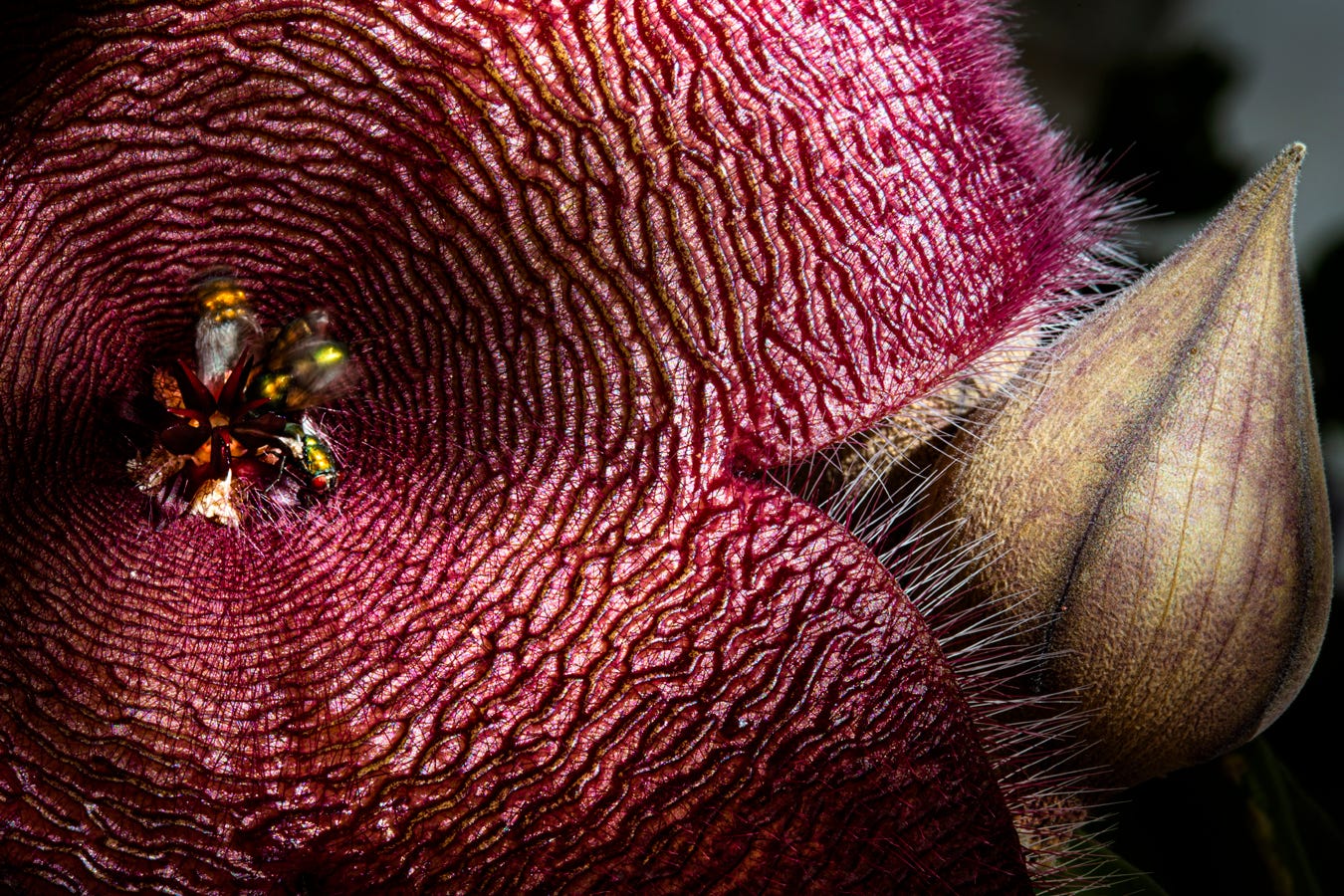
With a short introduction to the practice of ‘seeing’ with plants and image of the fly-enticing Stapelia gigantea of the Chihuahua desert by David Lauer (from Dark Mountain: Issue 28)
Introduction
In the ‘seeings’1, the flowers appear as themselves, inviolate, sometimes as people, uttering prophetic words, as directions or abstract shapes. They act as beacons and signposts, as guides. They show me their movements, their energy fields, their structure and how they relate to my own. When I place morning glory seeds under my pillow, a group of beings lead me to the top of a precipice and show me time in the universe. I see it stretched into infinity, compressed like a mussel shell. When I place betony in a glass, four dragons of different colours assist me to make an alphabet of plants; when I sleep beside flowering mugwort gathered at full moon, a young naked woman appears inside a cell where Mark and I are kept prisoner. ‘I have beautiful breasts,’ she says, and when we behold her beauty, we suddenly find ourselves outside the prison walls.
The practice was about encountering plants from what some call the right-hemisphere (as opposed to the controlling rational left hemisphere). It meant working with flowers metaphorically the way poets look at a tree - as a bridge between the visible and invisible worlds - Edward Thomas with aspens or Seamus Heaney with a hawthorn tree; mythologically, in deep time, the way Robert Graves contemplates the acacia or Celtic scarlet or kerm-oak; metaphysically, in the way Annie Dillard comes eye-to-eye with a weasel, or follows a creek during its year-long cycle.
The practice took us travelling: on a medicine journey with a desert bush in Apache country, dreaming with the aboriginal eucalyptus in Western Australia, defending a patch of willow trees with a group of activists in Oxford, contemplating under the Buddha’s pipal tree in Sarnath; with peyote in the Sierra Madre mountains, with liberty cap mushrooms in the Chiltern beechwoods, through a night garden in Norfolk stoned on hemp flowers, having a rethink about narcotics, about everything, using the flower as a lens through which to understand events, people, places, what it is to be a writer, to be female, to belong.
But the poppies always led us inward, into the territory of the imaginal. This is a story from our early practice days in Oxford, where the purpose of seeing itself was brought into question, by a bright orange ‘dreaming’ flower from California…
California Poppy
Southmoor Road, Oxford 1999
‘I cannot find myself,’ Joui said on the telephone when she rang out of the blue one day. We had known each other in Ecuador many years ago when Mark and I were travelling through South America. I stood in our English kitchen and looked into the bright summer garden. I remembered at that moment how we had driven with Joui one night in her huge American car around the empty misty streets of Quito in the company of a Columbian man she called a shaman. ‘Sometimes I just like to get in the car and drive without knowing where I am going,’ she said.
Joui told us that she had been suffering with liver cancer and recovered, but now the disease had returned. Could we help? It was a request that came out of nowhere: the sort of situation you get into without knowing where you are going. I found myself suggesting an inner realm travelling.
These investigative journeys were originally inspired by my research into modern plant spirit medicine and traditional shamanic work with the invisible realms. Although I was not interested healing work as it is commonly understood, I knew from my interactions with monkshood you could ask questions and receive a very accurate readout of another person’s energy body, where their trapped spirits were causing an imbalance in their mental, emotional or physical lives. In these travellings, the plants would show me the energetic elements of the situation, and I would write up my findings in a report. This seemed to me a very fair exchange. I could put my newfound skills to good use; my colleagues (as I saw them) could work with the material. However such bargains are not what most ill people have in mind when they request a hand. If you are working with medicine plants, you are expected to be a healer.
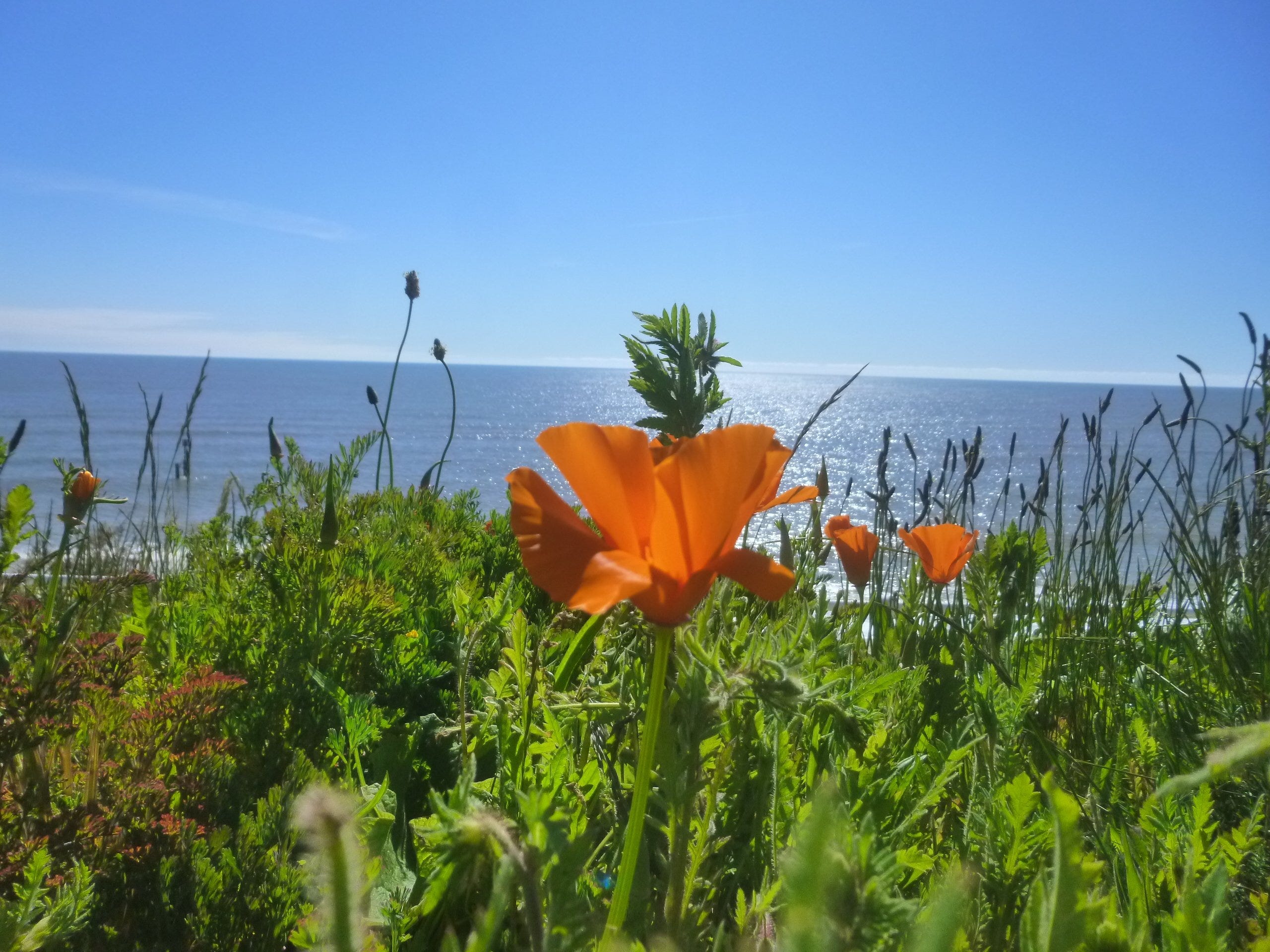
This is the beginning of the medicine inquiry and I am naïve and optimistic in such matters, so I fire ahead regardless. Joui was at that time living in California, so I instructed her to go outside and connect with whatever plants she felt close to and then find a quiet place to focus whilst I conducted a seeing. After we had fixed a time, I went into my room and lay down on my bed to gather my thoughts. As I did I noticed a flash of orange out of the corner of my eye. I looked out onto the balustrade of my window. There dancing in the evening light were several pots of California poppy. They were just coming into flower.
The California poppy is a beautiful and unusual poppy, with its shiny folded petals of brightest tangerine, and lacy intricately cut pale green leaves. In its native land the poppy’s springtime show takes your breath away, ribboning down the freeways and covering the distant hills in a great sheen of gold. Like all poppies however it is deeply mysterious and linked with the Underworld, power structures and the release of pain. Poppy is a shortened form of Persephone, the Queen of the Dead. I knew when I saw it, it was going to direct the seeing.
The session
In the seeing the California poppy made a dramatic entrance and directed several plants to energise Joui’s body and get her out of bed. Mugwort was the principle agent in this work. For many years Joui had worked with a Daoist teacher, and mugwort is the great Chinese cleanser of the meridians (moxa is made from mugwort plants), so I was not surprised it came in to instigate the work. What shocked me was the California poppy. Half-way through she suddenly announced that she had had enough of the lack of participation and non co-operation and called the whole show off. There is a lack of love and too much anger, she said.
I lay in the curtained darkness of my room. Outside the poppies gleamed in the twilight. I had also failed to ‘find’ Joui. I felt frustrated with myself, and also very heavy. Furious energies began to rip through me, like tigers. I went downstairs and shouted at Mark. Normally these seeings made me feel energised and clear, excited. I knew something was not correct. When Joui rang later, she asked me what she should do. Should she go to her teacher in San Francisco? What did I think? I felt I was being asked to take responsibility for something that was not mine to take. I told her I would do another session.
That night the white willow and opium poppy came into the seeing to deal with the pain and the dark energies I had seen that were stuck there. In contrast to the earlier drama, the session was very low key. Afterwards we heard nothing further from Joui. I presumed she had improved. Several months later we sent a letter wishing her the best for the new year and in return received a letter from her mother informing us that Joui had died. Almost a week after our conversation she had flown home where she spent her last days, facing what she had not until then seen. Warrior to the last, she took no pain killers.
The flowers had shown me that nothing could be done. But I had not realised that really meant that nothing could be done.
We held the letter in our hands and did not know what to say. The flowers had shown me that nothing could be done. But I had not realised that really meant that nothing could be done. For several days I felt a fool for having jumped to. Then I had a dream about Joui. She was freeing herself from a waiting room full of people. At the end of the dream she burst out of the Pacific sea in a flash of orange light. When I woke up I realised that although the ‘healing’ had not succeeded something else had. When I asked Joui to connect with the plants, it was a reality check. She realised that a few flowers were not going to save her. I was not to know was how ill she really was, and in some ways nor was she; she wanted someone else, anyone else, to tell her what was staring at her in the face.
There was something not right about this relationship and we both knew it as we struggled through our trans-Atlantic telephone call. We had known each other once in Quito, but we had not spoken to each other for five years. Water had flown under the bridge. There were too many gaps in our communication. These seeings did not operate within a traditional patient-healer set up but within the equality of relationship. I found myself in a unequal exchange in which I was expected to pick up the tab. It had nothing to do with flowers.
No amount of good intention or enthusiasm on my part could cover up this fact. Earth medicine requires human beings to realign with the natural world. Between people it requires a meeting of the heart. In these matters it is unequivocal. In the seeing the poppy was unequivocal.
She appeared in the French windows dressed in a shimmering orange dress. The room was empty, the light flat, the figure lay inert on the bed. You could say the flower was glamorous, like an actress, except in a seeing you behold everything in its energetic form. You are not working with the physical narrative, you see everything in terms of its vibrancy, its tone, emanation, colour, feeling. You do not see beauty in its conventional sense, you see beauty and harmony in its essence, from the inside. So you don’t see the poppy’s face. You sense her stature, the way she walks through the room. You experience her as a being who is in charge: highly organised, self-contained, mysterious and yet utterly on show. Her presence is exciting, of a high-vibration and subtle, refined; it is the opposite of the dull flatness of the room. Light emanates in all directions as she enters. You don’t see this light, you feel it, in the core of your being. This is the poppy energy, the Persephone energy, as it comes upstairs; it contains all the power of the Underworld to restore, revitalise and transform. So long as there is love and the door is open. But in this case the door was not open. The figure on the bed did not respond. There was no life in the room. Where in other sessions I had done there had been instructions: this needs activation, this connection needs to be made and so on, none were given me. The poppy called everything off.
You don’t see this light, you feel it, in the core of your being. This is the poppy energy, the Persephone energy, as it comes upstairs; it contains all the power of the Underworld to restore, revitalise and transform.
After the session I called everything off. Although the report I had sent to another seriously ill friend had helped her recover, I decided I would do no more inner realm travelling for others.
The bargain
I knew, but not experienced until that moment, the bargain you are expected to make in this kind of medicine interaction. I had, by this time, read many ethnographic works about shamans. I had worked with modern healers inspired by these traditional ideas. In my night dreams, native medicine people had come and given me instructions: from Mexico, from Peru, from North America, from Siberia. I had sometimes witnessed them cure people with certain plants. But unlike many of my contemporaries, I was wary of becoming a practitioner of this curative aspect of their art.
For thousands of years these healers have suffered spiritually (and often physically) on behalf of their tribe. This has always been a dangerous business. Traditional shamans have sometimes been killed if they don’t come up with the goods. In no anthropological report do you find an account of medicine people actually wanting to do this work. This is because it is a hard and lonely life, and you suffer greatly. Nevertheless you are recognised for your high intelligence and technical skills and people, though they may fear you, also respect you.
In modern times, however people who do this work are not regarded in this light. Nor is the responsibility of the illness shared because the world-view of the shamanic healer is not the same as the patient’s. The shaman looks into the patient’s situation and sees the whole world at play; the modern patient only sees themselves, assuming that these plant helpers are, like allopathic pills, simply there to make them better. But the truth of the matter is that they are not.
California poppy is the least shamanic plant you can imagine. Though it is used as a mild sedative, most often for children, it is not really a physical medicine plant. It is, as the seeing showed me, all about inner glamour and its principle quality is one of self-direction. It belongs entirely to a canon we would later call the flowermind. I was just not aware of this at the time. So though it seemed I had made a mistake by conducting this seeing, I had not. Joui realised she had to leave California and return to her parent’s home in Florida. She wanted to leave this world in full consciousness in front of her family. That was something her soul wanted to do. To direct her own final appearance, in the manner of all warriors, with great courage and style. I needed to see that my relationship with the plants was not a traditional one, that of allies and healer. We were exploring other avenues of communication, creating an Earth medicine show in which our human abilities to be self-directed, self aware, in charge of our own destiny, were paramount.
The exit
It was not easy to extricate myself from this healer paradigm. We are brought up to believe that we are supposed to suffer on the behalf of others, to sacrifice ourselves to the sick and damaged and the less fortunate. But the California poppy left the sick room because she said it was not correct that her lightness was dragged down by other people’s heavy karma. To hold this energetic idea within oneself and let the thoughts and feelings that oppose this statement surface, is to experience the dilemma of the age. We feel we should not be light. We feel we should pay for other people’s damage. We should not be here wearing a lovely orange dress and be on show. We should crucify ourselves instead of shining our light.
We feel we should not be light. We feel we should pay for other people’s damage. We should not be here wearing a lovely orange dress and be on show.
In whose interest is this idea upheld? Is is our own? This is not a question we like to ask. It is an unpalatable reality in our social world, the transference of energies that from one person to another. We like to think of ourselves as enlightened and well-meaning, impervious to each other’s thoughts or emotions, but the fact is we are not: invisible forces are at play under the surface of words and appearance in our daily lives, and these energies affect us. The field in which these forces interact is what you see in an inner realm travelling. In the sickroom, you are looking at the accumulated effects the untemperered mind and will have upon the human body. You are not in charge of what appears before you. You are deciding what kind of enlightened move you need to make.
To see in these energetic terms requires the intelligence and equanimity of the heart. In the heart’s clear gaze you can look at what is really going on. Only the heart is bold enough to look at the darkness that is of the tribe’s own making. In this matter of transference, all peoples of the world are equal, from the Amazon rainforest to the Western suburb: all of us download our negative feelings onto one another, and raid each other for the good, the shiny and the positive. We expect other people to deal with the flak we have caused by our own antagonism. Shamans spend a good deal of their practice extricating ‘darts’ out of people’s energy bodies. As modern people we think we are beyond such superstition. But whatever our rationality tells us, everyone has other people on their mind. We can all go into houses and feel spacey, low, gloomy, nervous, cold, and feel liberated when we walk outside into the fresh air. The truth is human beings are sensitive creatures and we pick up vibes.
Poppy, flower of the Underworld, deals with vibes. She can enter a room and show you what energies are flying about behind the social façade. It’s not personal, she tells you. If there are no heart vibes, there is no deal. It’s a rule of thumb. You don’t establish right relations by wanting others to change, you do it by considering what part you are playing in any energetic exchange. Is there a feeling of the heart? Is it 50/50?
Mostly you wise up. Suffering on behalf of others, is how you unwittingly give your life-force to furthering an antagonistic human world. You are deluded into thinking this is an act of love. Don’t call this love, the poppy was showing me, it is the fallacy of sacrifice. The idea that you can, even should, take on another’s suffering is a dangerous idea. You think you are selfless and compassionate, but actually you are interfering with that soul’s purpose, and by extension your own. When you are burdened with another’s unprocessed rage or karma, you can less easily walk your own path.
Of course if you are sick you want to be well and you sometimes need outside assistance. This is natural. The trouble comes when you do not ask yourself why this sickness has happened on a personal level, a collective level, on an Earth level, and what steps you can take to align yourself. This is why our karma – the ‘sins’ of our forefathers we carry in our souls – does not get transformed. And the world becomes heavier and heavier. Earth medicine requires you deal with these sins – those heavy untransformed energies you carry, acquired from your heritage, your history, your country, your sexuality, your work, the darkness that lies in your own heart. If you intend to lighten this world, release your spirit from the wheel, find the solar path home, the poppy was saying, you do not give your soul’s cultural checks and balances to others to deal with, least of all to those who had no part in your imbalance. And perhaps least of all to the plants and the Earth who have suffered so gravely in our hands.
In the past, the people had a radically different relationship with the planet. The shaman lived on the edge of communities where he or she was recognised to be the master of the dimensions, master of the hunt, who could convene with the spirits of the land and of the people. Their presence was vital: it kept the relationships between all beings in balance. However most Western people do not live in this kind of community or wild landscape anymore. We live mostly in cities, where the airwaves are jammed with interferences, in rooms and in bodies where life is flattened and inert. Our minds run along rational lines and we do not speak with the animals or the clouds. And so, even if we meet a modern shaman who could communicate with the spirit realms, we are unused to seeing our lives in energetic terms. We find it difficult to accept that our ills have been caused by this world we live in, by the dead who possess us, by our neighbour’s jealousy, by the ill-intentioned sorcery of the radio and newspapers. We just want this healer to take these consequences away and do some healing for us. Just as we would a regular doctor.
In this we do not take any kind of responsibility to realign our world. We think of ourselves as damaged wounded children and that somehow this illness is none of our doing. This renders us not only weak but makes us all victims. This is a cruel untruth. For though many of us have suffered greatly, we could take charge of our lives. We could choose to be self-directed. We could free our wills, our hearts, our minds. Healing lets us off the hook somehow and off the hook is not where we want to be if we want to be free. We need to be on that hook and feel its cruel barb. If we want to release ourselves from the cage the modern world puts us in, we have to know we are in a cage, what that feels like, what it means. Then we can act.
If we want to release ourselves from the cage the modern world puts us in, we have to know we are in a cage, what that feels like, what it means. Then we can act.
When I received the news that Joui had died I realised that playing the medicine woman was part of this cage. There is a great romance about shamans and medicine people in the modern world. In the ‘80s there were a myriad books in which young modern city women, like myself, met dynamic and feisty sorceresses in the backwoods of Canada or in the deserts of Mexico and were initiated into their canny and intelligent medicine ways. These characters worked with leaves and roots, with deer and stars, and something deep, earthy and magical stirred in our beings. This was the mythos working in our nature-starved imaginations, inspiring many of us to venture outside the town walls, into the woods and the mountains, and there was nothing wrong with that. There was nothing wrong either about seeing ourselves as female beings of transformative power and intelligence instead of silly creatures who only know about frocks and babies and chocolate, or at best some kind of clever men in drag.
The problems came was when we tried to be the medicine people ourselves. When we looked into the faces of our fellows, and saw their suffering and wanted in our deepest hearts to make them well. If you are a feeling being, you do not wish for others to suffer, especially those you have loved and travelled with, those who have given you shelter as Joui had once all those years ago amongst the high peaks of the Andes, who have made you welcome in a land where you were a stranger.
The truth of the matter is that we have to know our own business. The solar path is very particular on this. And so is the California poppy, a flower that knows all about the Underworld and the price you pay for not minding it. Your natural lightness and colour cannot be weighed down by another’s dark history, she said. It is there to inspire the new.
You learn the hard way. People think consciously or unconsciously you should take on their burdens for them: as their unexpressed rage, their nightmares, their family ghost pursue you down down the corridors of time.
It took me a long time to put on my shiny orange dress and direct my own show.


You can read more about the medicine flowers of The Plant Practice here.
Seeing: A method of communicating with other dimensions. Providing a set and setting – quiet space, concentration, time – in which you can perceive images and messages to and from other lifeforms. A seeing gives a visual and feeling demonstration of a plant’s workings – an energetic configuration of its qualities and how they relate to the human world. Access to these shared imaginal realms requires flexibility and imagination on the part of the seer.
The seeings require feeling to work. If your thinking mind holds control over your perception, your feelings will not be able to access your seeing faculty – the inner eye and heart. You will be prevented from seeing a composite picture because the thinking mind, which works in duality and mechanical or sequential ‘trains’ of thought, cannot make sense of a plant visit’s multi-dimensional information. The heart however is able to assimilate many kinds of input at once and organise it into a coherent and meaningful whole.
– from Appendix 2: 52 Flowers That Shook My World
These words in particular struck home: "Suffering on behalf of others, is how you unwittingly give your life-force to furthering an antagonistic human world. You are deluded into thinking this is an act of love. Don’t call this love, the poppy was showing me, it is the fallacy of sacrifice. The idea that you can, even should, take on another’s suffering is a dangerous idea. You think you are selfless and compassionate, but actually you are interfering with that soul’s purpose, and by extension your own. When you are burdened with another’s unprocessed rage or karma, you can less easily walk your own path." Self sacrifice is expected, mainly of women, in our (and many other) cultures and it takes hard work to loosen its grip (being post- menopausal helps). I like the fierceness and impeccability of this post, thank you.