

Requiem
On liberation and speaking with the dead

This day two years ago my dearest companero Mark collapsed on the kitchen floor and never got up again. I was writing a Substack post outside in the caravan and only knew something was amiss when I heard him bellow my name, and saw his hand waving through the cat flap. Even now, I wish I had been with him earlier, because he was already mid-stroke when I called the ambulance. I never got to say goodbye when he was fully conscious.
Last year I marked his ‘death day’ by doing all the things he loved to do: having a long bath, visiting flowers, eating chips, dancing … This year I am, in the manner of Dias de Los Muertos, cooking up a storm of his signature dishes: Mexican refried beans (with scarlet runner beans from Hodmedods), Greek potatoes, kale fritters, lemon drizzle cake and his favourite ferment, curtido. It will be a kitchen metaphysics day. I will open a bottle of biodynamic wine I’ve been keeping, and we will toast the wonderful life we had together by the fire.
I say ‘we’ because Mark, in spirit, never left. He is elsewhere in this mysterious universe but also close to my heart. His body, of course, is becoming an oak tree in a Buckinghamshire wood. Everyone who has loved deeply speaks to the dead in their everyday lives, we just don’t talk about it to the living, or have a culture where these dialogues are normal. But we perhaps should cultivate the practice. ‘Eternity’, as the writer once wrote, is not something that begins after you're dead. It is going on all the time. We are in it now.’ How to live life knowing that is something only the dead can teach us.
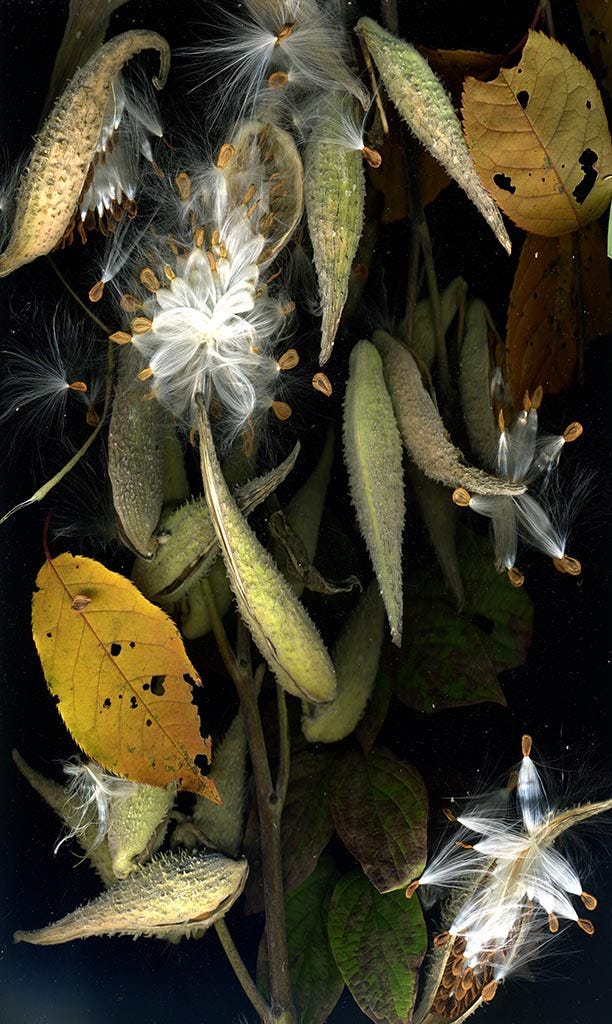
(With artwork from Dark Mountain: Issue 19)
London 1994
I am looking at a ring. It is made of yellow gold with small emeralds studded around it. A handsome antique ring, but nothing spectacular. But if you look closely it has a secret: inside there is a small hinge, which opens to reveals a cavity. It is a mourning ring and the secret compartment is to hold a lock of a dead beloved’s hair.
The ring belonged to my mother, it was her engagement ring and she wore it every day until she died. I am weighing up her jewellery for the auctioneers, and pausing at her collection of mourning rings, most of them simple bands inlaid with black enamel, some inscribed, that were often worn in the Georgian and Victorian eras, alongside mourning dress and black armbands. For some reason my father loved giving my mother these dark rings, alongside jet necklaces, earrings and brooches. He was old-fashioned in that way.
I am not sentimental and don’t wear jewellery but I sit with those rings for a while longer. Mark and I are living in my parents’ house in London, emptying it of contents, distributing them, selling or giving away to others. We will be here for six months and when we leave it will be empty. It is a liberation practice. Every drawer opened, every letter read, every wish granted. When we leave I will keep nothing but a few photographs of myself as a small child, my mother’s painting table, my father’s carving knife and folk, and his two-volume1964 Oxford dictionaries.
I will also take a large amber costume necklace from her dressing table that one day in the future, when we fall on hard times, I will try and sell at an amber shop in Southwold. ‘It’s good looking piece’, said the assistant, ‘but I am afraid it’s plastic’. I laughed out loud. My mother had sworn it was African, and for some reason I believed her, even though I know, living in East Anglia, amber drifts across the sea from the North. The laughter though I kept.
It’s important you laugh with the dead as well as feast with them. Mark made everyone laugh and still now every day when I remember him, I smile as much as I cry. He was a great fool. All great metaphysicians work within the comedic, with the poignancy of loss and time. With the butt of the joke on them.
Gone is gone, he would say. Death is not the end, I would reply.


The birds
Suffolk, 2026
There is a realm, known as the astral, held in moon’s gravity, where on the soul level all the feelings, people, places that are not acknowledged or relinquished are kept. In our travelling years, Mark and I worked very hard to clear these invisible ledgers of obligation from our conscious lives, so that, like my parent’s house, all that would be left is light and air.
Soon after he died, a robin came into the house, and helped himself to the cat’s dry food. He would appear when I went into the garden and observe me, and sometimes sit on my hand. Mark was a prodigious liberator of birds; even fierce ones like a sparrowhawk he could catch in his hands and release them when they became trapped. At his funeral celebration, a tiny goldcrest flew into the window and stunned itself. It looked dead. So I had to rush out of the woodland hall and put it against my heart, in the way he always did, and it revived shortly afterwards in the hearse driver's hands. So, in the ancient way of augury, I knew the red-breasted bird was a messenger.
‘Oh look,’ I said to my friend Josiah, as he alighted on the spade, ‘Mark has come to say hello.’ He looked at me gravely.
‘He has gone, Charlotte. But he will always be a part of you.’
‘I know,’ I said, and went inside to fetch the lunch. The robin flew over and perched on to my chair and peered at him more closely.
‘I think Mark is disagreeing with you there,’ I laughed.
After he went, I waited to have a dream about him. We had had a dreaming practice for over ten years. The practice was two-fold: it showed us how to clear our historical houses and make connection with the living earth: animals, medicine plants, ancestors, mountains. The dreams were like a bridge. But once we had done our clearing, gone though the past’s inventory and made those vital connections, the wind changed and we found ourselves with a different practice. The dreams vanished. So, I had to wait a long time, listening out for a certain sound.
When I was young, I ran away to Italy to write a novel. At least that’s what I thought I was doing. In fact, I was remembering the Earth and my soul, shuttered by a city life. I found harbour in a faded villa on the Ligurian coast, a place full of light and flowers, circled by white doves. Its caretakers set me to .work in the kitchen where they cooked and hosted an informal supper club. Francis would send me out into the garden to dig the earth, collect chard, pick olives and cut up wood for the fire. One day he found a wild pigeon caught in the chicken coop.
Listen, he said, and gave me the bird to hold. When you hold something in your hands, you are responsible for its freedom. You have to know what that feels like. The bird leapt out and flew into the chestnut wooded hills. Years later, when our life journeys had taken us to opposite sides of the world, I will ring Francis as he lies dying in the south of France and he will describe to me the shape of his room and the terrace garden he has made. And that night I will dream of a wild pigeon that is beating itself against the window in my room and I will go to the window and set it free.
What matters is that you liberate the spirit, so it can go wherever it wishes to go. What you don’t want are ghosts, trapped in buildings. When I was younger and less adept, unquiet spirits would seek me out. I would go into old houses and start shivering, or wake with the feeling someone was sitting on my chest. Often, these were sites of religious practice: a furious abbess, murdered monks. We live in a haunted land, where ghosts are treated as subjects for stories and entertainment. But in reality, they are vengeful beings, unloved and unrequited, and cause havoc to the living. All Indigenous people know this. They know you need give the dead proper burial. The dead need to become ancestors and for that they require the living to honour and let them be free.
*
One night I awoke inside a dream, hearing a sound of wings in the corridor. I went out and a bird flew out of Mark’s room and into mine. It was a small bird: a blue or great tit and was fluttering against the window. So I opened it.


Vigil
In 2020 Mark and I took part in a series of events on death, dying and change called Borrowed Time. It was hosted by the Devon-based organisation art.earth who also collaborated with our Dark Mountain ‘requiem’ Issue 19. Following three lockdowns, and a year later than scheduled, the main gathering eventually took place online. And even though its subject was vast and unfathomable, and customarily observed with silence, deference, bound tight by tradition and form, the intimacy of the screen discussions brought us into a sudden and startling kinship. Each of us touched by our own and others’ mortality in a way that felt both ancestral and entirely modern. Mark absolutely loved these events and the preliminary ‘Plague Cafes’, as he did the sangha sessions that had come out of the pandemic era. It opened out territory of spirit that is rarely shared between people, where he felt at home.
Remembering this, I am republishing the short text written for Borrowed Time to capture of some of the mood and existential attention of those sessions. The book was a gathering and celebration of the voices, images and creative practices made in the wake of the symposium by organisers Richard Povall and Mat Osmond.
MORTUARY
Somewhere a vigil through the long dark night is being held, while most of us are sleeping.
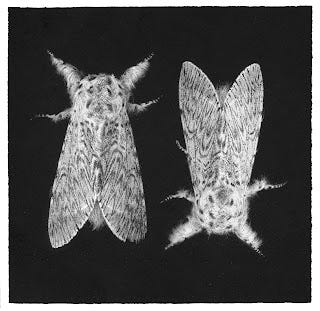
While most of us have our eyes on the road, Kathryn Poole alights from the bus to Stockport, her eye caught by the flapping of a dead owl’s wing in the tailwind, as if it were still alive. She will render the speckled feathers in pen and ink as a memorial.
While most of us neglect the cost of toil on human bodies, Tom Baskeyfield enters a mortuary on the side of a Welsh mountain, and puts his hand on the cold slate slab. He will render the stone on paper with graphite, stippled with the lives of the men who died while mining this slate, and once were laid here.
While most of us avert our gaze, forests are disappearing, the animals are leaving, the seas are emptying, our hearts are yearning without knowing why. No canvas seems large enough to hold it.
SHROUD
On an island in the Baltic that is the last matriarchal community in Europe, women in flowering dresses gather around a casket in the dead woman’s kitchen, to pray and sing and mourn. In Armenia, the academic told us, where the villagers also once gathered in each others’ rooms to bid farewell, there are now specially built funeral houses. Grief is no longer a shared thing among the community, but an individual concern. A quiet has prevailed, where once there were tears and sorrowing.
We gathered as if in these old kitchens, learning over tables, looking into each other’s faces. sharing prayers and blessings, in the spirit of the vigil. We spoke of the dead. We found that there are still women in our own land who stitch their own grave goods boots from deerskin, decorated with oak gall, who provide felt blankets to swaddle the dead before they go back into the cold ground.
Who will wrap us, who will sing for us? Who will remember our passing through? The warmth we once held?
Who will keep vigil for us in the dark night as it approaches, keep the fire of the world alight?
MEMOIR
I am writing this from memory, long after the gathering that was the Borrowed Time symposium. I am remembering, because time doesn’t go in a straight line, like history. To bring renewal to the world it needs us to loop and feed back, in gardens and culture.
In her memoir about grief and mourning A Year of Magical Thinking Joan Didion realises her cataloguing everything about her relationship with her dead husband was an attempt to reverse time, to stop the forty years of living closely from disappearing into a black hole. Her fearless remembering of the minutes and years, are a writer’s capacity for finding moments that are like keys to a closed door: significant because they reveal the life that counts, our presence here together. What remains when you take away the issues, the opinions, the thoughts and numbers, that whirl about in our heads. What really matters.
I lit a fire, she said, I closed the curtains. He praised my work. We swam with the tide into the cave at Portuguese Bend, You had to feel the swell change. You had to go with the change, he said.
TUMULUS
Sometimes I go to sit on the tumulus down towards the Blyth river. Crowned by silver birch and rowan trees, it houses the dead from hundreds of years ago. Why is it that these archaic places feel like a solace, an anchor in rocky times? Not my kith lie buried here, but my kin. People who lived close to the land, and these ancestor trees, the deer, the lichen on the rocks. My body, my blood. Once we waited here at winter solstice for the light of the new sun to fall into the chamber, holding our breath, the breath of the year.
How can I value my life, if I do not have the dead close to me? Who else can take us back down into the kiva and kur, where all life and regeneration begins, to remind us of our obligation to give back.
WAKE
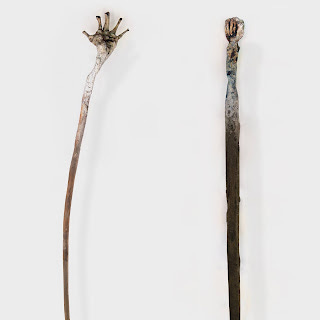
I made a book of the dead with fellow writers, wrapped in a winding sheet. In it we placed the keening of birds and people, these staffs with hands that clasp the wind, the flowers that light the way to the Underworld
Everything I write, my body, my intelligence is compost for the future, said the poets. We are a nurse log for the new, happy to sit in the dark with you, doing this work, not knowing what comes after.
It is a mood and an attention that is held in these encounters, because the dead, our kin are in the room, because with this relinquishment, the fierce joy of remembering the presence of living beings comes to us. The memory you keep treasured in the heart’s locker for others to stumble upon.
What does the mind remember? A grinding sound, keeping the machinery of an illusionary world in place, an ancient hostility, distracted by a fast-flickering screen.
What does the writer remember? The shape and colour embedded in stone, leaf, skin, lichen, the sound of water, the curlew calling from the river, your voice. This library of Earth, sunlight held in matter.
The great mystery of Earth is time, said the blind writer, holding a book in his hand.
We borrowed it, and forgot to bring it back.
Our return is overdue.


BOOKSHELF NEWS
This month Mark’s flower book, The Plant Pamphlets was released as a PDF. You can read about his 12 signature flowers (and recipes for those delicious fritters and ferments) here.
Art.earth is compiling a new book called The Breath We Share. gathering ‘embodied and creative practices for a living and dying world’. You can find details of their call out here. Deadline for submissions is 15th March.
This is beautiful Charlotte 🙏 I shall raise a glass of Tempranillo to Mark tonight x
Dear Charlotte, thank you for writing about grief so tenderly and openly. grief has been moving through me recently and it is something I am learning to understand since it takes so many shapes and textures. we need more social spaces to feel grief together, we need a language that talks about death not as an ending but a regeneration and a becoming. thank you.